

The best sound insulating internal doors in the UK work as part of a well-sealed doorway, not as a door leaf alone. In England, for doors between corridors and rooms in flats, the Approved Document E route can use a door with a minimum mass per unit area of 25 kg/m²; alternatively, according to the UK Government, the minimum laboratory sound reduction index is Rw 29 dB. Gaps around the frame or beneath the door can still let noise through.
A heavier door may help reduce noise, but seals, the surrounding structure and ventilation also affect the result. Choosing an acoustic door means considering how it fits the room and how sound travels through the entire opening.
This guide explains how sound moves through doorways in homes and workplaces, what to consider with sliding and pocket doors, and how England’s Approved Documents E and F relate to doors and ventilation. You’ll also learn why a quieter space depends on the complete doorway, helping you make a considered choice that balances noise reduction with practical use.
Key Takeaways
- Understand why sliding and pocket door designs can make acoustic sealing more challenging, and what to look for in test information.
- Identify where quieter internal doors may help at home or work, from creating privacy to separating busy areas.
- Learn how to trace noise around a doorway, including the role of gaps, seals and the door itself.
- See how England’s Approved Documents E and F relate to sound insulation and ventilation, and how door choice can balance both.
Can Sliding and Pocket Doors Be Soundproof?
Sliding and pocket doors can help reduce noise, but their moving construction makes an airtight seal harder to achieve than with a conventional hinged door. Solid-core acoustic doors with well-fitted seals are generally the stronger choice for reducing sound. Costs depend on the door construction, seals and sliding system specified.
Solid-Core Construction and Acoustic Seals
A solid-core door leaf has more substance than a lightweight hollow door, which can help limit sound passing through the panel. Even a substantial door can transmit noise through gaps at its edges. Acoustic seals around the frame and a threshold seal help close these paths. Pocket doors need particular attention because the leaf slides into a wall cavity.
For a hinged door, consider the complete assembly: the leaf, frame, perimeter seals and threshold. A brush seal may suit a sliding arrangement, where a compressible seal could obstruct movement. No seal makes a door completely soundproof, and the sliding mechanism still needs to operate smoothly.
Acoustic Ratings and Sound Reduction
Acoustic ratings describe tested performance, rather than promising silence in every room. Soundproof door models are stated to reduce sound by up to 47 dB, but that figure applies to the tested door system. A 5 dB allowance may separate a laboratory result from performance in construction.
For example, an on-site sound reduction index of Rw, R = 27 dB requires a door element with a laboratory test value of 32 dB. Use the rating to compare like-for-like products, then consider the frame, seals and installation conditions. “Acoustic” describes sound-reducing performance; “soundproof” should not be read as complete sound isolation.
There is no single UK price for soundproof internal doors. Construction, acoustic rating, sealing components and the choice of sliding or pocket hardware all affect the specification and cost.
Acoustic Standards and Field Measurements
Laboratory and on-site figures answer different questions. According to the British Standards Institution, BS EN ISO 10140-2 is the laboratory measurement standard for airborne sound insulation of building elements. BS EN ISO 717-1:2020 is the rating standard for airborne sound insulation of elements, including doors.
For sound measured between rooms, BS EN ISO 16283-1 is the field measurement standard, according to the British Standards Institution. A laboratory rating describes a tested element; field measurement captures the room-to-room result, including sound paths around the door. Check which standard and test setting support a stated acoustic rating before comparing products.
Residential and commercial applications
At home, an acoustic door can help separate rooms with different sound needs. A bedroom beside a television room, for example, may benefit from reduced noise transfer in the evening. A home office opening onto a busy hallway has a different priority: limiting everyday conversation and movement during calls. Choosing sound insulating internal doors UK homeowners can rely on starts with matching the door to the room’s purpose.
Start by identifying the sound source and the room where you need greater privacy. Then consider how often the doorway is used, whether the door will usually stay closed and whether glazing matters. A glazed door can preserve borrowed light between spaces, but acoustic performance depends on the complete door assembly, not appearance alone. Match the choice to the room’s purpose.
In workplaces, reducing sound may matter between meeting rooms, consultation spaces, offices and shared corridors. A meeting room beside reception has different needs from a staff room beside a quiet office. Consider sound in both directions: keeping conversations private inside a room and limiting noise from nearby activity. Sound insulating internal doors UK workplaces choose should reflect how each space is used.
Daily use also shapes the practical choice. A door on a busy route may open frequently, so ease of operation and reliable closure matter alongside acoustic performance. For a room used for confidential discussions, consider the doorway’s seals and surrounding construction as well as the door leaf. A quieter door cannot address sound travelling through an adjacent wall or ceiling.
For either setting, note the room’s function, likely noise sources, privacy needs and ventilation requirements before choosing a specification. In a house, that might mean prioritising a bedroom beside a living area; in an office, it could mean protecting a meeting room beside a corridor. These details help narrow the suitable style and construction. Explore door designs for different rooms as you consider the balance between appearance, use and acoustic needs.
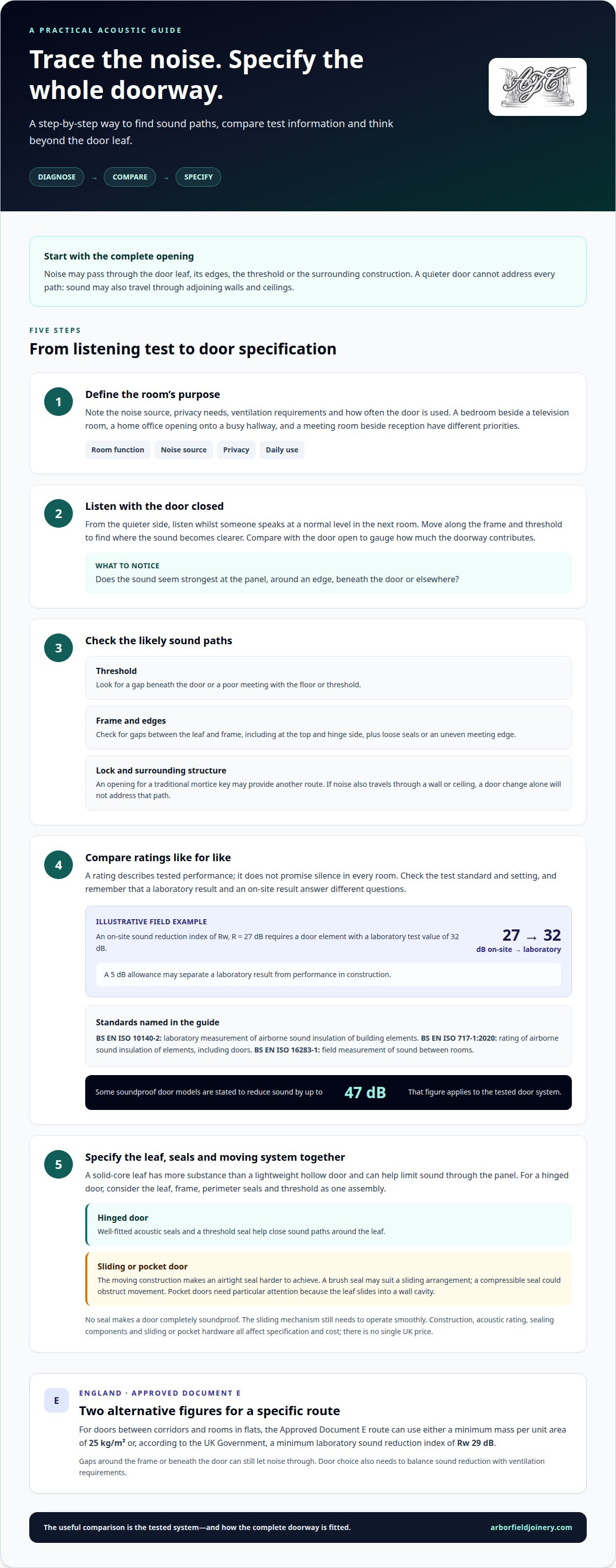
Diagnosing sound paths through doors
Noise can pass through the door leaf, its edges, the threshold or the surrounding construction. Sound may also travel through adjoining walls and ceilings, so a quieter door cannot address every route. Start by locating where the sound seems strongest, then inspect the whole doorway rather than focusing only on the panel.
With the door closed, listen from the quieter side while someone speaks at a normal level in the next room. Move along the frame and threshold to find where the sound becomes clearer. A visible gap beneath the door, a loose seal or an uneven meeting edge may indicate an air path. Compare the result with the door open to gauge how much the doorway contributes.
- Check the threshold: sound may pass beneath a door that does not meet the floor or threshold closely.
- Inspect the frame: look for gaps between the leaf and frame, including at the top and hinge side.
- Consider the lock: an opening for a traditional mortice key can provide another route for sound.
If noise is most noticeable around the edges, suitable perimeter seals and a threshold seal may help reduce transfer. The seal needs to meet the door when closed without preventing it from latching. If sound seems to pass evenly through the leaf, its construction may be the more relevant factor. Treat the lock, frame and door as parts of one assembly.
A simple listening check can help distinguish a local gap from sound travelling through the wider structure. If noise remains strong beside the wall, ceiling or floor, changing the door alone may not address that route. For a lock opening, a euro lock avoids a traditional keyhole through the door. First address the source you can identify, then reassess the closed doorway. This approach helps target improvements rather than adding seals where they cannot address the main path.
England’s Approved Documents E and F
In England, Approved Documents E and F address different considerations: sound insulation and ventilation. For a door between a corridor and a room in a flat, the Approved Document E context includes a minimum laboratory sound reduction index alternative. The UK Government states that this alternative is Rw 29 dB. This figure applies to that stated context, not automatically to every internal doorway in homes or workplaces.
The same context also provides a mass-per-unit-area route. These alternatives help show why choosing an acoustic door involves more than selecting a heavier leaf. The door’s measured performance, its position in the building and the complete doorway assembly all matter. First identify whether the door separates a corridor from a room in a flat, then establish which performance route applies.
Ventilation needs consideration too. According to the UK Government, under the applicable edition of Approved Document F, an internal-door free area equivalent to a 10 mm undercut beneath a 760 mm-wide door may be used for ventilation. That opening can leave a path beneath the door, which may also allow sound to pass between rooms. A design decision therefore needs to consider both airflow and sound reduction, rather than treating the gap in isolation.
For a project in England, follow this sequence: identify the building and doorway context, establish the relevant performance route in Approved Document E, then account for ventilation under the applicable edition of Approved Document F. Sealing every edge may not be suitable if the opening contributes to ventilation. The doorway’s dimensions and function affect how its acoustic and ventilation needs fit together.
Choosing a door is one part of that decision; the opening and its intended use matter as well. Explore internal door options as you consider the balance between room separation, ventilation and sound.
Arborfield Joinery
Arborfield Joinery offers a range of internal doors to consider when choosing a door for a quieter home or workplace. Options include Oak Doors, Walnut Doors, White Primed Doors and Urban Doors, with styles to suit the room’s appearance and everyday use.
Use the points in this guide to shape your choice: identify where sound travels, consider the doorway’s ventilation needs and look for acoustic performance information suited to your project. Appearance and material are part of the decision, while the complete assembly and its installation affect sound reduction.
If you’d like to discuss choosing an internal door, contact Arborfield Joinery.
Make your next door choice with confidence
Before choosing a door, decide what matters most in the space: greater privacy, a calmer place to work or preserving light between rooms. Let that priority guide the balance between appearance, everyday operation and sound reduction. A considered specification starts with the room’s purpose, not just the door’s finish.
To explore sound insulating internal doors in the UK, browse Arborfield Joinery’s range of internal doors and choose styles that suit your home or workplace. The range can help you shape your choice while keeping the character of the space in mind.
Contact Arborfield Joinery to discuss your internal door requirements and take the next step towards a more comfortable space.
Frequently Asked Questions
Why Choose Acoustic Internal Doors?
Acoustic internal doors can improve comfort by separating spaces where privacy matters. At home, that may mean reducing disturbance between a study and living room; at work, it may help make a meeting space more private. Their value depends on the room’s purpose and the noise you want to address, not on a fashionable label alone. Consider how the space is used before choosing a door.
Can an Existing Door Be Improved?
An existing door can sometimes be improved, particularly if its frame is in good condition and the door closes evenly. For example, a door that rattles when shut may need attention to its hinges or latch before you consider replacing it. A suitable seal may help if the existing fit allows it. If noise comes through a neighbouring wall, changes to the door will not address that route.
Replacement Leaf or Complete Acoustic Doorset?
A replacement leaf changes the door panel, while a complete acoustic doorset includes the frame and matched components. A leaf may suit a sound frame that already fits properly. Consider a doorset if the existing frame is damaged, poorly aligned or part of the noise problem. The key question is whether the current frame can support the performance you need.
What Is the Difference Between Acoustic Doors and Soundproof Doors?
An acoustic door is designed to reduce sound transmission; “soundproof” suggests that sound is blocked entirely. In practice, even a well-performing door will not create silence if noise has another route into the room. Treat “soundproof” as a claim to examine carefully, and focus on tested performance and the particular needs of the space.
What Makes a Door Soundproof?
No single feature makes a door completely soundproof. A substantial leaf, a close fit and compatible frame components can all help limit sound transmission. The opening’s condition matters too: a well-made door in a damaged frame can leave weak points. For a home office, consider whether you mainly need to reduce routine household noise or protect confidential conversations.
How Is Sound Insulation in Doors Measured in dB, and What Do UK Acoustic Ratings Mean?
Door sound insulation is expressed as a sound reduction index in decibels, with an Rw rating used for airborne sound insulation. A higher tested rating indicates greater reduction under the stated test conditions, not a guarantee of the same result in every room. The British Standards Institution identifies BS EN ISO 717-1:2020 as a rating standard for airborne sound insulation of elements, including doors. Compare ratings measured on the same basis.
Share:
How to Apply Teak Oil to External Joinery for Lasting Protection
How to Repair Scratched Wood Finish on Stairs